FORUM THEATRE - Action for positive social change
Session 6 - Who will play which role?
Now, with the preparation of the last session let’s return to the play formats we created in Lecture 3 and 4.
This will be like devising any play except we have to be sure that certain Forum Theatre elements are in place.
So work in your group which devised the storyboard that you've created in the last session
Look again at the storyboard and decide:
Who will play which role?
In our warm-up today we worked on becoming other characters. Use that knowledge to decide who will be the main characters – the Central Character, the main Oppressor or Oppressors etc and who will play sisters, friends, family, neighbours. Some people may play a number of different characters. We can show this by a change in body language and the addition of a hat, a shawl or other prop. So think what do they look like, how do they walk, what rhythm do they have?
Also remember when casting that the Central Character will probably be replaced a lot in the audience interventions, so will not be involved in those!
With your casting decided, we are going to develop the scenes in your plays. So we shall revisit the images you made of each scene.
And then
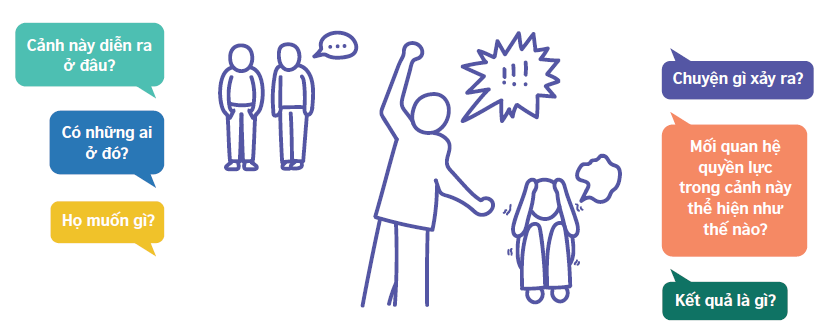
- Determine the basics of each scene to be created:
- Who is there?
- What do they want?
- Where are they?
- What happens?
- What choices are made or blocked?
- What are the results of those choices?
Set up a basic setting for each scene
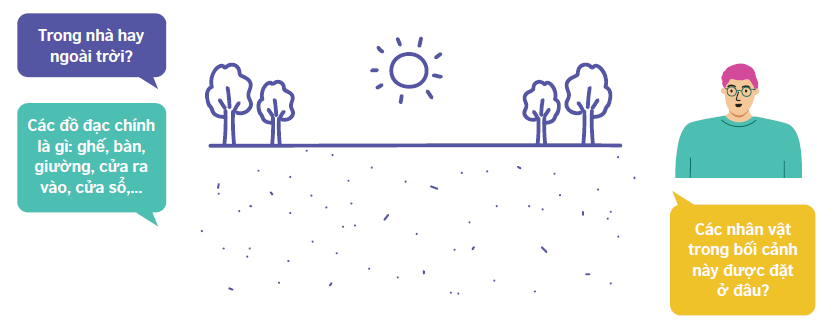
- Is it inside or outside?
- Where are the main elements: chairs, tables, beds, doors, windows, etc. etc.
- Where are the characters in this setting?
- Now improvise each scene, one by one, to start to find the journeys of the characters. How to do this? In character walk through your setting. Then walk through and meet the other characters in the scene. What do you say? How do you react? Is there a confrontation? Try to create it?
- Draw out text from improvisations, letting colleagues take notes and construct a rough text. Each time you improvise a scene the text will start to refine itself
- Notice that you are becoming the playwright! We do not need an external playwright because they will not understand the speech, mannerisms, rhythms of your community. You will and you can write it.
- When you have worked on each scene, run through the whole play and see if it makes sense. Make adjustments, try again. Rehearsing is repeating and refining.
- Take time until you are happy with it.
- Try it out in front of the other groups and take on their comments and adjust your play as necessary.
Please note: Remember you are only creating a short play. 15 – 20 minutes is enough. Even a 10-minute play is good for this training and then expand it to 20 minutes when you go out into the community
To help you:
- Think about the staging
We are making community theatre and need to be able to play in small and simple venues, inside or outside for small to medium sized audiences (100-300). So we don’t need big expensive theatre scenery and we don’t need very complex lighting.
So that we can be flexible and creative, we can make our scenes with very simple items. If we have 4 cubes of about 70 cm in each dimension and 2 wooden planks 130cm we can create all sort of spaces; chairs, tables, desks, beds, offices, shops etc and we can change scenery very fast (10 - 15 seconds in full view of the audience)
- Here is an Example Forum Theatre play structure:
This is particularly useful if you are not accustomed to writing plays – it gives you a simple, possible structure as a basis of your play. You can always add scenes to it if necessary but remember it should not become too complex.
- Scene 1: Introduce the central character, their desires, the oppressor(s) and the oppression (3 minutes).
- Scene 2: Introduce a potential ally witnessing a further stage of the oppression (4 minutes). a further stage of the oppression (4 minutes).
- Scene 3: Show a big point of conflict between the central character and oppressor(s), the central character does not win (7 minutes).
- Scene 4:Show the negative consequences for the central character arising from the conflict, with the central character still trying to battle with the problem but being pushed down (4 minutes).
- Scene 5: Show the central character at their lowest point, in despair and crisis (2 minutes).
Check:
- Who is in the scene?
- Who enters first? (if all characters are on-stage together the audience can get confused)
- Where is it?
- When is it?
- Who has least power?
- Who has most power?
- Who wants what?
- What is the journey of each scene (i.e. What is different at the end of the scene from the beginning?)
- What crossroad moments are built into the scene for future interventions?
This means:
- Thinking about character
- Thinking about action
- Thinking about relationships
- Thinking about emotions
- Thinking about the stage image
All the above will help the audience understand the situation clearly.