FORUM THEATRE - Action for positive social change
Session 3 - Let’s turn our stories into plays for Forum Theatre
Let's start our acting lessons with the training for bodies, voices and creativity
- Mirroring with music - for observation, accuracy, and physical expression
- The group gets into pairs and names themselves 1 & 2.
- They stand facing each other.
- 1 starts to move very slowly, carrying out an action.
- 2 reflects the action, as if in a mirror.
- Swap over.
- Music played during the activity.
- Vocal Strength
(i) Chewing gum: as described in Lecture 2
(ii) Humming
To give the voice the power it needs is not a matter of pushing the voice. We need to use the body to amplify the volume. Just as a guitar has a sound box behind the strings to resonate its vibrations, we have parts of the body which naturally amplify our voice. By being aware of them and maximising them, we can find richer and louder tones to use. The two main areas for resonance are the head and the chest. Here is how we can feel their resonance and increase it:
- Start to hum with the lips closed. Choose an easy note where you are comfortable and relaxed. Breathe deeply (abdomen only).
- Try to feel the hum on your lips. If you can’t, slightly relax the lips and vary the note you are humming up and down until you feel your lips starting to “buzz”. If you gently bring the teeth together behind the lips you may feel that they are also “buzzing” with the sound.
- Now place your hands on your face, let your fingers give a little pressure around the nose, under the eyes, on the forehead. Vary the pitch of your hum to try and feel these parts resonating with the sound. When you can feel it, try to relax those areas – perhaps by massaging them – to increase the resonance.
- Do the same with the top and back of your head. These are useful resonators, using the structure of the skull to amplify sound. Again, vary your note from high to low and back again, until you feel the “buzz” here.
- These are the head resonators. See if you can feel them all working at the same time.
- Now place your hands on the front of your chest and continue humming. It should be easy to feel the vibration here, perhaps on a lower note than in the head.
- Take the hands to the lowest ribs, and to the side ribs. Try to find a note to resonate here. You may need to gently massage the fingers into the ribs here to feel the resonance. If it is difficult try to imagine that your mouth is in the place you want to resonate – that the voice is coming out of your body at that point. This can help sensitise the area.
- When you have explored all these areas, try slowly to open the lips so that you are making a “Mmaaah” sound, and try to maintain the resonance while you do it.
- Work on this regularly until your resonator/soundbox is fully helping you.
(iii) How many 'A'
- The group stand in a circle.
- One person steps forward and makes a vowel sound together with a gesture which expresses an emotion or idea. (NB. Vowels might be different in each language; English has aah, ee, oh, ai, oo.)
- The rest of the group copies the sound and gesture exactly.
- Another person steps forward with a vowel sound and gesture, expressing a different intention, the group repeats and so on. Make sure everyone has a few turns.
- Work through all the possible vowel sounds in your language, making sure you find as many variations on how you might express that sound, in volume, tone, speed, length etc.
Extension:
- Once you have worked through sounds, choose a sentence. Find as many different possible ways of saying that sentence. For example, ‘I love you’ can be said in many different ways. In English, ‘I love you’ can be said in such a way that it actually expresses ‘I hate you’, or ‘I want you’, or even as a question ‘I love you?’.
- Now try one person saying the sentence directly to another person in the room. The second person then responds to what has been said. In this way, a small verbal dialogue begins. 'How many 'A' ?' helps participants to discover sounds, words and begin to play with them.
- Counting group
- The group sit, stand or lie down in a circle.The group will now count up to ten, one person at a time.
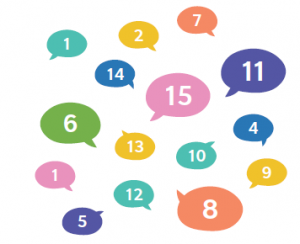
- No one knows who will speak first, second, third etc. The ordering of who says the numbers must be completely random without signalling to each other, without anyone leading the group or taking control or indeed being passive.
- The group play by using their senses and it is the whole group’s responsibility to get to 10, to choose when to speak, and when to be silent.
- If two people speak at the same time, even for an instant, the group returns to number one.
- Try the reverse, counting from 10 to 1. Is this easier?
- Now repeat it with closed eyes! This exercises your other senses.
- Image of the words
- Collect themes and issues that the group is interested in working on, for example ‘love’, ‘fear’, ‘school’, ‘the harvest’, ‘homelessness’, ‘domestic violence’, ‘growing old’… The themes might be collected through discussion, or there may be themes which have recurred from previous exercises which you may want to explore in more depth.
- Ask the group to stand separately from each other, in a circle with their backs facing into the circle.
- The facilitator will call out one of the themes. The participants are going to make a still picture with their bodies that expresses this theme for them.
- Count the group down from 10 to 1 ending with ‘turn around and show your picture!’.
- At this point the group should all turn inside the circle to face each other and spontaneously present their individual images with their bodies.
- Ask the group to hold the image they are making at the same time as taking a look at the other images in the circle.
- The participants are invited to say what they can see in the images, they notice which shapes recur, what emotions and situations come to mind and what this says to them about the theme.
- The group turns back into the circle, another word is chosen and so on…
- Once the exercise is established, different participants can call out themes.
Variation:
- As above.
- This time the images are ‘brought to life’ in various ways. For example, the facilitator says ‘play sound’ – the images remain still but the participants make corresponding sounds which go with their images. Or ‘play movement’ – the participants bring the images to life through movement’, or ‘play in rhythm’, the images come to life on a rhythm and so on.
- The facilitator can also instruct the participants to move toward to someone with a very different image. The participants move like statues on wheels, holding their image in place but travelling forward. They make pairs with the person who seems to be in a different shape to theirs. These groups of images can thereby be brought together into very short quick scenes with the pairs moving and having a dialogue with each other – ‘play scene’.
- The same can be done by participants holding their image and moving toward others which are similar to theirs.
- Groups and shapes
- Ask the group to move around the space, tell them you are going to call out groups which they must get into as quickly as possible.
- When they are in those groups you are going to tell them a shape or object which they must find a way of showing as a group. They must find the most dynamic way of making that shape, using different levels, with attention to detail etc.
- For example ‘Get into groups of 6, make a circle’, ‘Get into groups of 3, make a star’, 'Get into groups of 7, make a market place’…
- As you progress, the groups and tasks should get more challenging. For example: ‘get into groups of people with the same colour eyes as you, make the word theatre’, ‘get into pairs with a person who is most different in height from you, make a bird on a pond’, ‘get into groups of people with the same size feet as you, make a bicycle’…
- You can also start to introduce themes or issues you want to explore through the kind of group they are in, and the task: ‘get into groups of 12, make a factory paying low wages’, ‘get into groups of people born in the same month as you, make a family who have received some good news’…
- After a while you can ask groups to look at each other’s pictures and talk about what they see.
- The groups can introduce sound and movement to the shapes they have made, so they start to become potential scenes which you can develop.
- Danger and Protector game
- Ask the group members to walk around the room in various directions, not following anyone but taking their own path. The group should keep moving throughout the exercise.
- Whilst they are moving, ask the players to each think of someone in the room but not show who they have chosen. Tell the group the person they have just chosen is going to represent something that they fear. Their task therefore is to try to keep away from the thing that they fear, to try to keep as much distance between themselves and the fear.
- Let this continue for a while. The dynamic in the room will start to change.
- Stop them in a freeze frame.
- Ask the group members to keep this person as representing the thing they fear, but to now also choose a second person in the room and not show that they have chosen them. The second person that they have chosen will now represent the thing that can protect them from their fear - a protector.
- The aim of the game is now for the participants to try to keep the ‘protector’ between them and their ‘fear’.
- Tension can be added to the game by asking the group to move faster, or counting them down from 10 to 1, saying that by the time you get down to 1 their fear will be at its most extreme. This is a good place to stop the game.
- At the end of the game ask the group to freeze and look at the stage picture they have made.
- They can now point to the people who represented their fear and then to their protector.
- Ask the group to make observations, for example how did their breathing change, how did their bodies change, what shapes did the group make, how did the game and the roles they played feel etc.
- Think about that last game and how it relates to Power and what was introduced on.
- Reflection on the previous sessions
- What thoughts or feelings does the previous sessions evoke in you?
- How do you find those activities or content helpful for you to make forum theatre?
- Which part would you like to explore more?
- Quick images of trafficking (no words) show slideshow back to others
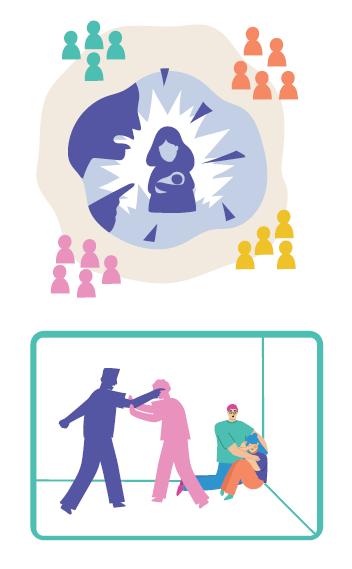
- Working in groups of 4-5
- Each one use the rest of their group members’ bodies as people and objects to create a photo of modern slavery/human trafficking as you now understand it. So if a group has 4 members, there will be 4 “photos”. Remember to show the role and the power/powerlessness of each person in it.
- After some time to prepare the photos, groups present their series of photos to the class.
- "Yes, and…"
- The players get into pairs. They are going to improvise a short story together, one by one, one sentence at a time.
- Player 1 makes a sentence to start the story.
- Player 2 adds to continue the story with 'Yes, and…'
- The player 1 adds a sentence with 'Yes, and…”, so on till the end of the story.
- The “Yes and...” will serve to open up your ideas. If you say No, then you are blocking the story.